

How To Choose The Right Baby Gear In 2026
Baby gear is supposed to make daily care safer and easier, but a clever feature is not helpful if it is hard to install, impossible to clean, or no longer fits your child’s stage. When I evaluate gear, I start with safety, then ask whether it supports healthy development and whether our family can use it correctly on a tired Tuesday.
Quick Answer
Choose baby gear in this order: safety, developmental fit, everyday usability, and compatibility with your home, car, routines, and budget. Check current safety information, recalls, instructions, and manufacturer age, height, and weight limits before first use. The right setup is rarely the most feature-packed; it is the safe, simple gear you can install, clean, and use correctly every time.
Table of Contents
- Quick Answer
- Our Top Picks
- Start With Safety, Not Features
- Match Gear to Age, Weight, and Developmental Stage
- Judge Everyday Usability on a Tired Day
- Fit Gear to Your Home, Car, and Caregiving Routine
- Keep the Setup Simple, Maintained, and Rechecked
- Frequently Asked Questions
- Sources & References
Our Top Picks
Affiliate disclosure: if you buy through these links, we may earn a commission at no extra cost to you.


Start With Safety, Not Features
Safety is the first filter for every category, whether you are looking at a stroller, baby monitor, high chair, nursery furniture, infant toy, or toddler safety product. Check that the product follows current safety standards, has clear age and weight limits, and feels stable and well constructed. Look for a design that reduces hazards such as tipping, strangulation, overheating, and suffocation rather than one that simply adds more buttons or accessories.
Read the instruction manual before the first use, not after something feels confusing. Check product recalls and compare your child’s current age, height, weight, and developmental stage with the manufacturer’s limits. A product that was suitable a few months ago may need to be adjusted or replaced as your baby grows, begins moving more, or reaches a new stage.
Car seats are a good example of why correct use matters as much as product design. Infant car seats are rear-facing only and typically have a carry handle and detachable base; they are designed for newborns through roughly 12 months, depending on the seat’s height and weight limits. Convertible car seats begin rear-facing and later convert to forward-facing use, while rotating car seats swivel toward the vehicle door to make buckling easier. BabyGearWise, citing NHTSA, notes that nearly half of car seats are installed incorrectly, so the seat that works best is the one that fits your vehicle and that your family can install and use correctly.
Be especially cautious with a used car seat. Avoid one unless you know its complete history, can verify that it has not expired, and know that it has never been involved in a crash. A seat can look perfectly fine after a crash and still not be appropriate for reuse.
Match Gear to Age, Weight, and Developmental Stage
Age labels are only one part of the decision. Your child’s current weight, height, movement, and developmental abilities matter just as much. A newborn, a baby who is beginning to sit, and a toddler who can climb will use the same general categories of gear in very different ways. Recheck the limits whenever your child grows quickly or reaches a new milestone instead of waiting for a problem to appear.
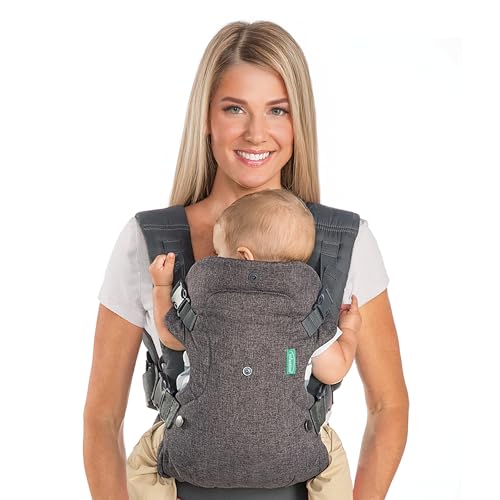
Good gear supports development; it does not replace interaction. A floor mat gives a baby room for tummy time and movement. A baby carrier can support proximity and responsive caregiving when it is used within its instructions. High-contrast books and simple infant toys can encourage looking, reaching, language, and sensory-rich interaction. None of these needs to be complicated or battery-powered to be valuable.
Apply the same thinking to toddler gear. A stroller should be appropriate for your child’s current size and stage. A high chair needs to match the manufacturer’s limits and provide the support intended for your child’s current abilities. Toddler safety gear should be reconsidered as your child becomes more mobile, reaches higher, opens things, or begins testing boundaries. The goal is not to keep a child in one setup forever; it is to keep the setup appropriate as the child changes.
Judge Everyday Usability on a Tired Day
The best gear is gear you can use correctly when you are carrying a baby, running late, or cleaning up after a long day. Imagine the real moment: folding the stroller in the rain, finding a pacifier in a full diaper bag, wiping oatmeal from a high chair, adjusting a baby carrier, or setting up a baby monitor while another child needs your attention. If the basic task is confusing or takes too many steps, that matters.
Cleanability is part of usability. Look for surfaces and parts you can realistically clean after spit-up, sunscreen, food, or a diaper leak. A diaper bag that is difficult to empty will eventually collect crumbs. An infant toy that cannot be cleaned according to its instructions may spend more time in a cupboard than in your baby’s hands. A high chair that requires a complicated disassembly after every meal is likely to become a source of frustration.
Simple gear can also reduce mistakes. Fewer components and fewer steps may mean fewer rushed installations, skipped instructions, and opportunities for misuse. This is particularly important for products that rely on correct fitting or installation, including car seats, carriers, strollers, and toddler safety gear. Convenience is useful only when it does not make the safe way harder to follow.
Fit Gear to Your Home, Car, and Caregiving Routine
Baby gear has to fit your actual life, not an imaginary one. Think about where the stroller will be stored, who will carry it, which caregivers will use the high chair, and whether the nursery furniture leaves enough room to move safely around it. A product that works beautifully in a large nursery may be frustrating in a small bedroom, shared living space, or home where gear must be moved several times a day.
Your vehicle and your caregivers matter just as much when choosing a car seat. A convertible seat may last several years because it transitions from rear-facing to forward-facing use, while an infant seat may be convenient for moving a sleeping newborn in and out of the car. A rotating seat may make buckling easier because it turns toward the door. None of those features removes the need to check the manual, confirm the seat fits your vehicle, and make sure every regular caregiver understands the correct installation and use.
Consider proximity and responsiveness when arranging the rest of the home. A baby carrier may be useful because it keeps a baby close during ordinary tasks. A floor mat may be more valuable to your routine than another product designed only to occupy a baby. A baby monitor can support awareness from another room, but it should fit into responsive caregiving rather than become a substitute for checking on and interacting with your child. Nursery furniture and monitor placement should also be reviewed if the room changes, since rearranging furniture can change the safety of the setup.
Keep the Setup Simple, Maintained, and Rechecked
Choosing gear is not a one-time decision. Keep the instruction manual available and revisit the manufacturer’s age, height, and weight limits as your child grows. Check for recalls periodically and review any product that has been moved, adjusted, cleaned, or handed between caregivers. Correct use depends on continuing to use the product as intended, not simply setting it up correctly once.
Pay attention to changes in the way your child interacts with gear. A baby who is becoming more mobile may use an infant toy, stroller, high chair, or nursery space differently than before. A toddler may test the stability of furniture or the limits of safety equipment. If a product no longer feels stable, no longer fits your child, or has become difficult to use correctly, pause and consult the manual or manufacturer before continuing.
Hand-me-downs deserve the same careful review as new items. Confirm the product’s limits, instructions, condition, and recall status. For car seats, the complete history is essential because seats expire and should not be reused after a crash, even when there is no visible damage. A smaller, well-understood gear setup is often safer than a room full of products that are difficult to maintain or use consistently.
Frequently Asked Questions
What should I check before using baby gear for the first time?
Read the instruction manual, check current safety information and recalls, confirm the manufacturer’s age, height, and weight limits, and make sure the product is stable and appropriate for your child’s developmental stage. If it requires installation, practice until you can do it correctly without guessing.
Is the most expensive or feature-rich baby gear the safest?
Not necessarily. The safest choice is the product that is appropriate for your child, supports healthy development, fits your home or car, and can be used correctly and consistently by your family. More features can add convenience, but they can also add steps and opportunities for misuse.
What is the difference between an infant, convertible, and rotating car seat?
An infant car seat is rear-facing only and typically includes a carry handle and detachable base. A convertible car seat begins rear-facing and later converts to forward-facing use, so it can last several years. A rotating car seat swivels toward the vehicle door to make buckling easier.
Can I use a secondhand car seat?
Only consider one when you know its complete history, can verify that it has not expired, and know that it has never been involved in a crash. If any part of that history is unknown, avoid using the seat.
Does baby gear help with infant development?
It can support development when it creates room for movement, interaction, language, sensory exploration, or proximity. Floor mats, baby carriers, and high-contrast books can facilitate those experiences, but gear should support responsive caregiving, tummy time, language, and movement rather than replace them.
When should I reassess my child’s gear?
Reassess whenever your child’s age, height, weight, or developmental stage changes, and whenever you move or change the setup. Also review the product after a change in caregivers, a vehicle change, or any situation that makes the instructions or fit less clear.
When I choose baby gear, I come back to four questions: Is it safe, does it fit my child’s current stage, can we use and clean it correctly, and does it fit our real routines? Start with the item you rely on most, read its instructions, check its limits and recall status, and test it during an ordinary family moment. A safe, simple setup that works every day is worth far more than a crowded collection of features you do not have time to use.


